The joint management of Uluru-Kata Tjuta National Park by its traditional owners, the Anangu, and Parks Australia illustrates a model in which preserving one of Australia’s most famous landmarks relies as much on Indigenous knowledge as on engineering. Anangu rangers work with scientists to monitor the effects of drought and extreme heat on local flora. This bicultural approach remains rare worldwide for a UNESCO World Heritage site.
Buffel grass and salt erosion: technical threats to Australian landmarks
Buffel grass, an invasive grass, fuels fires and directly competes with native plants around Uluru. The ABC reports that the Northern Territory government declared it a weed in 2024. Parks Australia manages it through mechanical removal, chemical treatment and drone monitoring.
This case shows that conserving a protected natural site requires active land management, not just installing barriers or restricting access. The challenge is to maintain a healthy ecosystem around the monolith; otherwise, the landmark loses the landscape that gives it meaning.
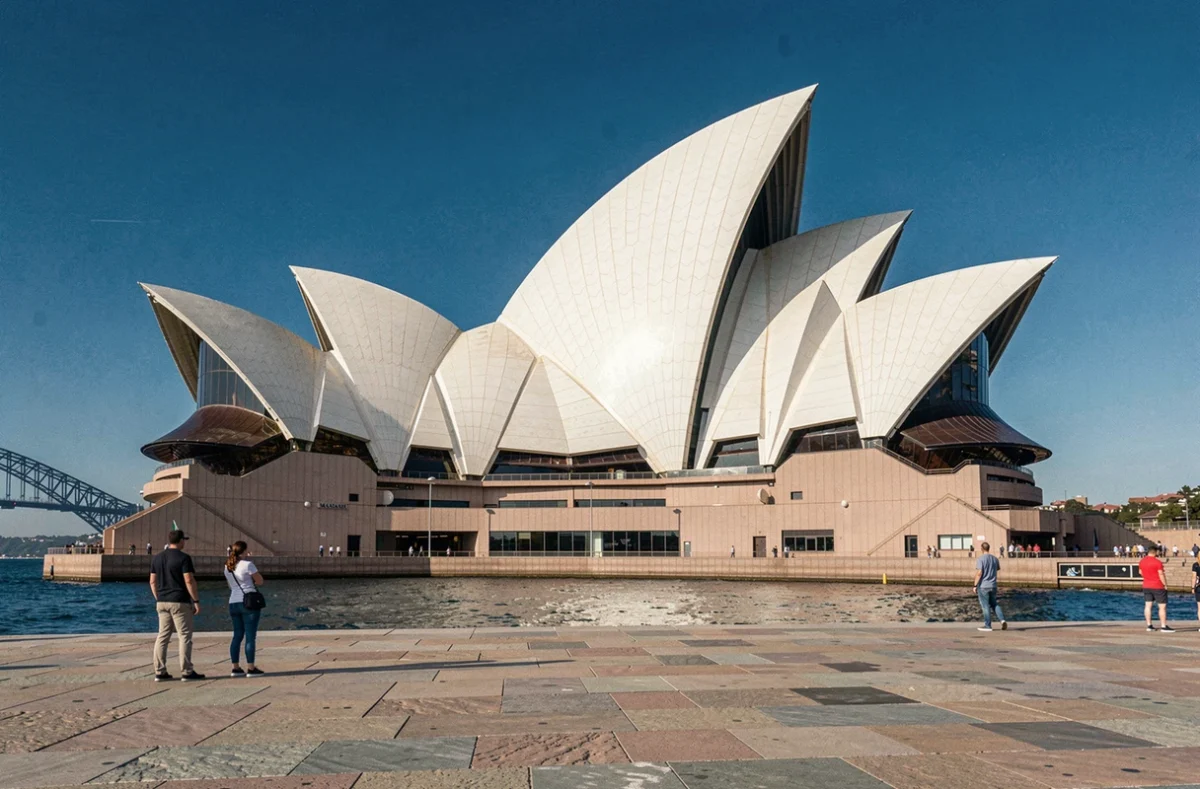
As for built structures, the Sydney Opera House is facing saltwater damage to the reinforced concrete along its northern promenade. Marine corrosion attacks the steel reinforcement and weakens exposed surfaces. An article on Australia’s famous landmarks offers a sense of the range of these challenges, from the mineral to the botanical.

Sydney Opera House: renovating a listed landmark without freezing it in time
The renovation of the Sydney Opera House Concert Hall, which reopened in July 2022, improved its acoustics, accessibility and stage facilities. The project shows that a World Heritage-listed landmark requires ongoing adaptation, not preservation in an unchanged state.
The technical challenge is to work on a structure made of prestressed concrete shells, designed in the 1960s, while complying with heritage restrictions. Every interior alteration must preserve the geometry of the exterior shells, which defines the building’s visual identity.
This approach sets Australia apart from many countries where heritage listing prevents any functional changes. Sydney treats its opera house as a living instrument, not a relic.
Australian war memorials: Kings Park Memorial, Cenotaph and Dorrigo
Australia has an extensive network of military memorials spread across the country. Three deserve particular attention for their role in collective remembrance.
- The Kings Park Memorial in Perth honours Western Australian soldiers who died in the two world wars. Overlooking the Swan River, it is a major venue for ceremonies each Anzac Day.
- The Cenotaph in Sydney, located at Martin Place, serves as a focal point for commemorations on 25 April and 11 November.
- The Dorrigo War Memorial in New South Wales honours local residents from this small rural town who died in combat. Its presence in a modest-sized community illustrates how deeply Australia’s culture of remembrance reaches, even into its least populated areas.
The Australian Vietnam Forces National Memorial in Canberra completes this network with a monument dedicated to conflicts since 1945.
Great Barrier Reef and Sea Country: conservation through science and traditional custodianship
Australia’s heritage is not limited to stone and concrete. The Great Barrier Reef is a natural landmark whose conservation directly involves Aboriginal and Torres Strait Islander peoples. The marine park authority recognises their role in managing and caring for Sea Country.
Practical initiatives bring together traditional communities, scientists and public agencies. A trial conducted in 2024 involved relocating turtle eggs to protect nests threatened by rising sea levels or predators. This kind of intervention combines traditional knowledge of animal cycles with conservation biology protocols.
This co-management approach challenges the very definition of a “landmark”. While a war memorial is preserved through the upkeep of granite and bronze, a coral reef is protected through fishing regulations, water quality management and the passing of ecological knowledge between generations.
The Bell Tower and Elizabeth Quay: Perth between heritage and urban renewal
The Bell Tower, on Perth’s waterfront, houses a collection of historic bells. Its copper-and-glass structure contrasts with traditional stone memorials.
Elizabeth Quay, a neighbouring urban development, has transformed Perth’s relationship with its river. Together, the Bell Tower and Elizabeth Quay form a heritage and recreation hub that attracts both visitors seeking history and locals out for a stroll.
The Wall in the Wilderness in Tasmania
In a rural setting, The Wall in the Wilderness offers a different approach to commemorative monuments. This wood carving tells the story of the people who lived in Tasmania’s highlands. Each carved panel documents an aspect of local life, from logging to the everyday lives of the pioneers.
The project continues to evolve year after year. This living quality echoes the ongoing work at the Sydney Opera House: an Australian landmark is not necessarily a finished object.
The diversity of Australian landmarks—from a sacred monolith to a rural war memorial, from a coral reef to a contemporary bell tower—reveals an approach to heritage in which preservation is never simply a matter of maintaining a façade. Indigenous co-management, the fight against invasive species and acoustic renovations at an opera house all serve the same purpose: keeping alive what gives a place meaning.