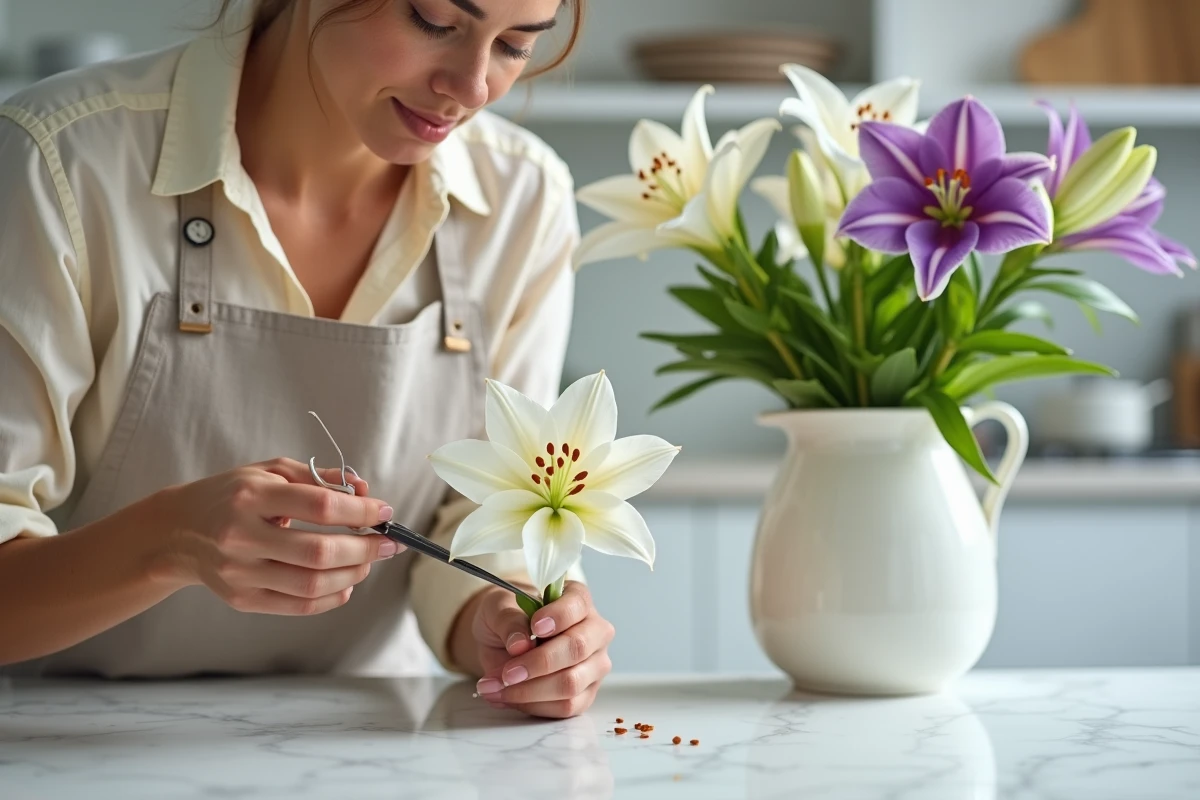
We just received a bouquet of lilies, placed it on the living room table, and two days later, an orange powder marked the tablecloth, the edge of the vase, and sometimes even the wall next to it. This stubborn pollen, released by the anthers as soon as the flower opens, is the primary reason florists systematically remove these organs before delivering an arrangement.
Understanding when to act and with what precise gesture makes all the difference between a bouquet that enhances the room and one that dirties it.
The right timing to remove lily anthers without damaging the petals
The ideal moment is just after the flower opens. At this stage, the anthers (the small sacs at the end of the stamens) are still moist, and the pollen is not yet powdery. One can then grasp each stamen at the base and gently pull downward without any dust dispersing.
Waiting one more day changes the game. Once the anthers dry, the pollen detaches at the slightest contact. If this is the case, it’s better to bring a paper towel underneath and pinch the stamen through the fabric to capture the powder as it passes.
When one wishes to remove the pistil from a lily flower under the best conditions, work over a sink or a surface that is easy to clean. A fine pair of tweezers is also suitable for varieties where the anthers are very close to the petals.
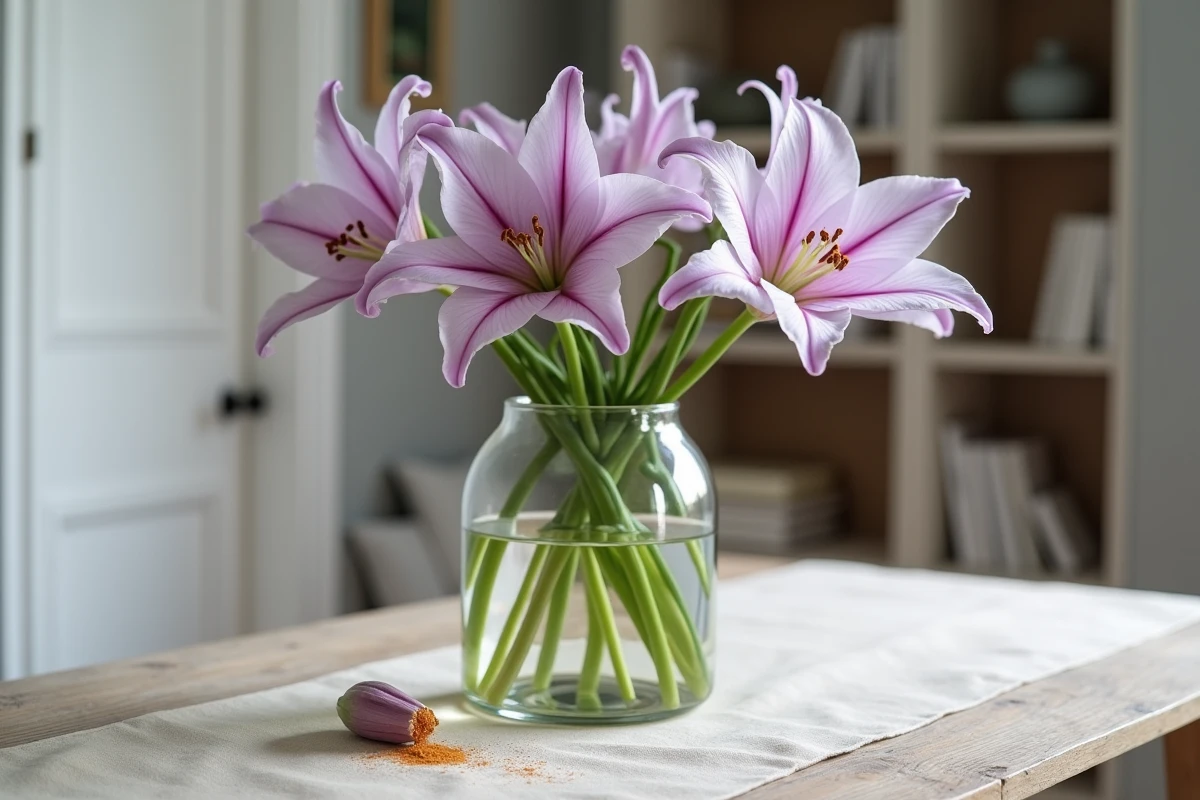
Lily pollen on fabric or furniture: how to tackle an already established stain
The usual reflex, rubbing with a damp cloth, is exactly what should be avoided. Water sets the pigment of the pollen into the fibers and transforms a superficial dust into a stubborn rust-colored stain.
The method that works on most textiles
- Let the pollen dry completely, without touching it, for a few hours.
- Use a piece of wide adhesive tape that you gently press onto the area to lift the dry grains without crushing them.
- Expose the fabric to direct sunlight for one to two hours: UV rays break down the residual pigment, and the mark fades significantly.
On a waxed wooden piece of furniture, a pass of adhesive tape followed by a swipe of beeswax is sufficient in most cases. On a lacquered surface or a stone countertop, a dry microfiber cloth does the job as long as no water is added at the start.
Which varieties of lilies produce the most pollen (and which are pollen-free)
Not all varieties of lilies pose the same problem. Classic Oriental lilies, which are highly fragrant, release a significant amount of colored pollen as soon as they open. Asian lilies are slightly less loaded, but their anthers remain very visible and messy.
So-called “double” or “pollen-free” lilies are selected for indoor decoration. Their anthers are either absent or transformed into additional petals, resulting in a fuller flower with zero risk of staining. They are increasingly available at florists, often under the commercial names Roselily or Lotus Beauty.
If one values the elegant appearance of the simple lily, with its six fully opened petals, the removal gesture remains the most reliable solution. Opinions vary on this point, but most florists believe that the simple lily maintains a more natural posture than the double version.

Floral arrangement with lilies: tips for a lasting bouquet
Removing the anthers is not only to protect the furniture. A lily without anthers retains its petals longer because the flower no longer expends energy producing pollen. This extends the bouquet’s lifespan by several days.
Complementary gestures to optimize longevity
- Recut the stems at an angle every two days and change the vase water at the same time.
- Place the bouquet away from a direct heat source (radiator, spotlight), which accelerates the drying of the petals.
- Remove wilted flowers as they appear: a wilted lily produces ethylene, a gas that ages nearby flowers faster.
- Avoid mixing lilies with fruits in the same room, for the same reason.
For decoration, one can also play with the height of the vase. A tall, narrow vase keeps the stems upright and highlights the trumpet shape of the flower. A low, wide vase is better suited for short-cut lilies, arranged in a crown, for a more modern effect on a coffee table.
Combining lilies with other flowers without overcrowding the bouquet
Lilies have a powerful fragrance and generous volume. Pairing them with discreet flowers (baby’s breath, astilbe, eucalyptus) avoids overcrowding. It’s better to have three well-opened lily stems than eight cramped in a vase that is too small.
The foliage of the lily itself yellows quickly once cut. Removing the lower leaves, those that would soak in water, limits bacterial proliferation and keeps the water clear longer.
In the end, the act of removing the anthers takes less than ten seconds per flower and addresses both the stain issue and the bouquet’s longevity. Whether choosing classic varieties or pollen-free lilies, good timing at the flower’s opening remains the starting point for a clean and lasting floral decoration.