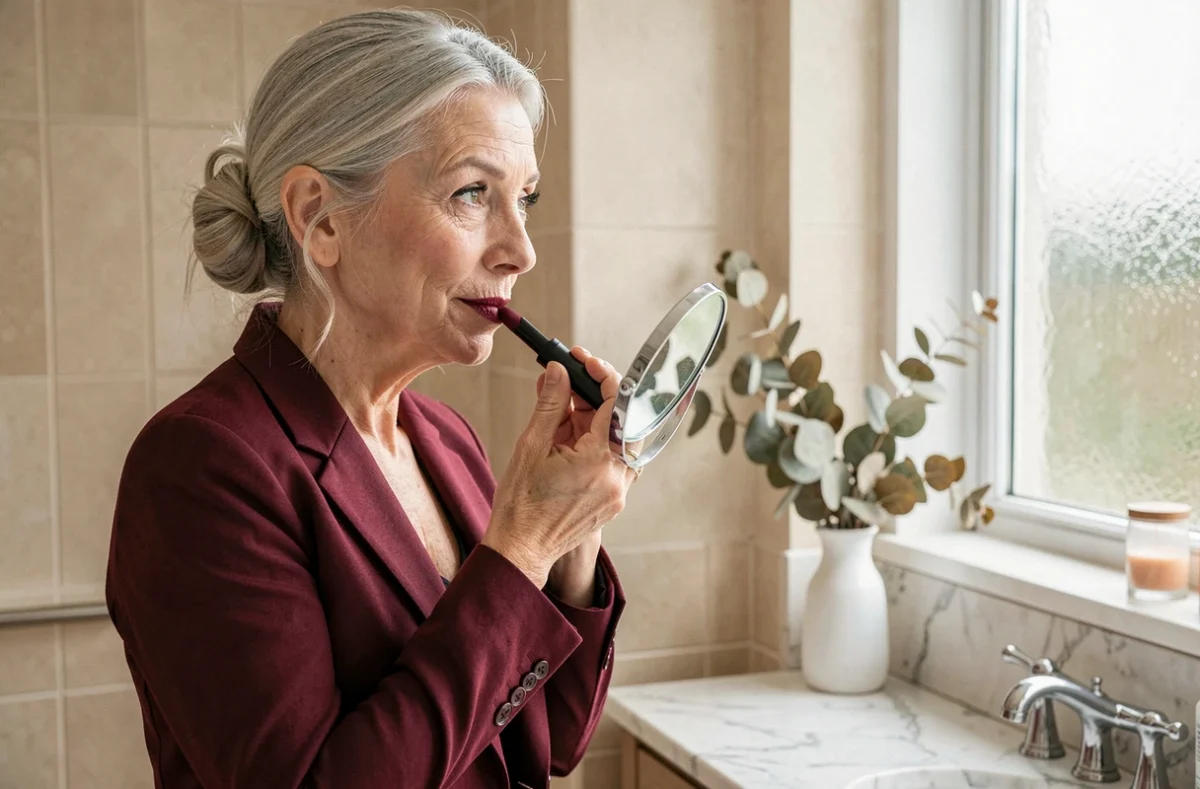
Lip texture after 50 is more than a cosmetic concern: it affects how pigment applies, migrates and wears. Choosing lipstick for mature women means understanding these factors before thinking about color.
Lipstick feathering and perioral fine lines: two problems, two solutions
Lipstick bleeding into the fine lines around the mouth and loss of definition along the lip line are often confused. They are two distinct issues that call for different solutions.
Feathering involves the pigment itself: a formula that is too fluid or too oily slips beyond the vermilion border onto the surrounding skin. Vertical fine lines act as tiny channels, drawing color in through capillary action. So lipstick can feather even when the lip line is well defined, and vice versa.
To limit feathering, we recommend a lip liner with a formula that glides on without being too dry. It creates a waxy barrier along the vermilion border. Applying the liner after moisturizing your lips (not before) helps it adhere better to a supple surface rather than dehydrated, flaky skin.
For fine lines, the solution is texture: a velvety semi-matte finish holds pigment better than gloss or a very oily balm. A comprehensive guide to lipstick for mature women explains the differences between formulas and how they affect wear.
Matte, satin and velvet finishes: how each texture affects mature lips
Traditional dry matte lipstick accentuates every line on lips whose hydrolipidic film thins with age. A matte surface absorbs light instead of reflecting it, making texture appear more pronounced.
The return of matte finishes in current trends comes with a nuance that mainstream articles often overlook: newer velvet-finish formulas (sometimes called “velvet matte”) contain emollients that help maintain some suppleness. The difference between these and classic liquid mattes comes down to the concentration of film-forming waxes and the absence of volatile alcohol.
How to choose the right texture
- Creamy satin: the most versatile option for mature skin, combining good coverage with comfort. It is forgiving of less precise application and does not emphasize lines
- Velvety semi-matte: ideal for bold colors (true red, plum) because it delivers opaque coverage without drying out the lips. Reapply if your lips feel tight after two hours of wear
- Pure gloss: best used as a dab in the center of lips over lipstick. Applied alone across the entire lip, it quickly migrates into perioral fine lines
- Long-wear liquid matte: suitable only for well-prepped lips (an occlusive balm the night before and a gentle exfoliation). Apply a single thin layer
Lipstick colors and skin undertones: the calibrated-contrast method
Common advice (pink for fair skin, coral for warm skin) is too vague. On a mature face, contrast matters more than finding the “right” shade.
With age, the natural contrast between skin, eyebrows and lips diminishes. Hair lightens or turns white, and the complexion loses saturation. A lipstick too close to your natural lip color (the famous “my lips but better”) can look washed out rather than natural.
Adjusting contrast to your undertone
Warm undertone (greenish veins on the wrist, golden skin): orange-based reds, terracotta shades and salmon pinks create enough contrast without making features look harsh. Avoid cool, blue-based pinks, which can make the complexion look gray.
Cool undertone (bluish veins, rosy skin): blue-based reds, raspberry shades and mauves work well. A cool-toned beige-pink nude is a better choice than an orange-beige shade, which can make the face look sallow.
Neutral undertone: this is the most versatile profile. Medium pinks, true reds (neither blue- nor orange-based) and berry shades all work. The pitfall is playing it safe with shades that are too muted.
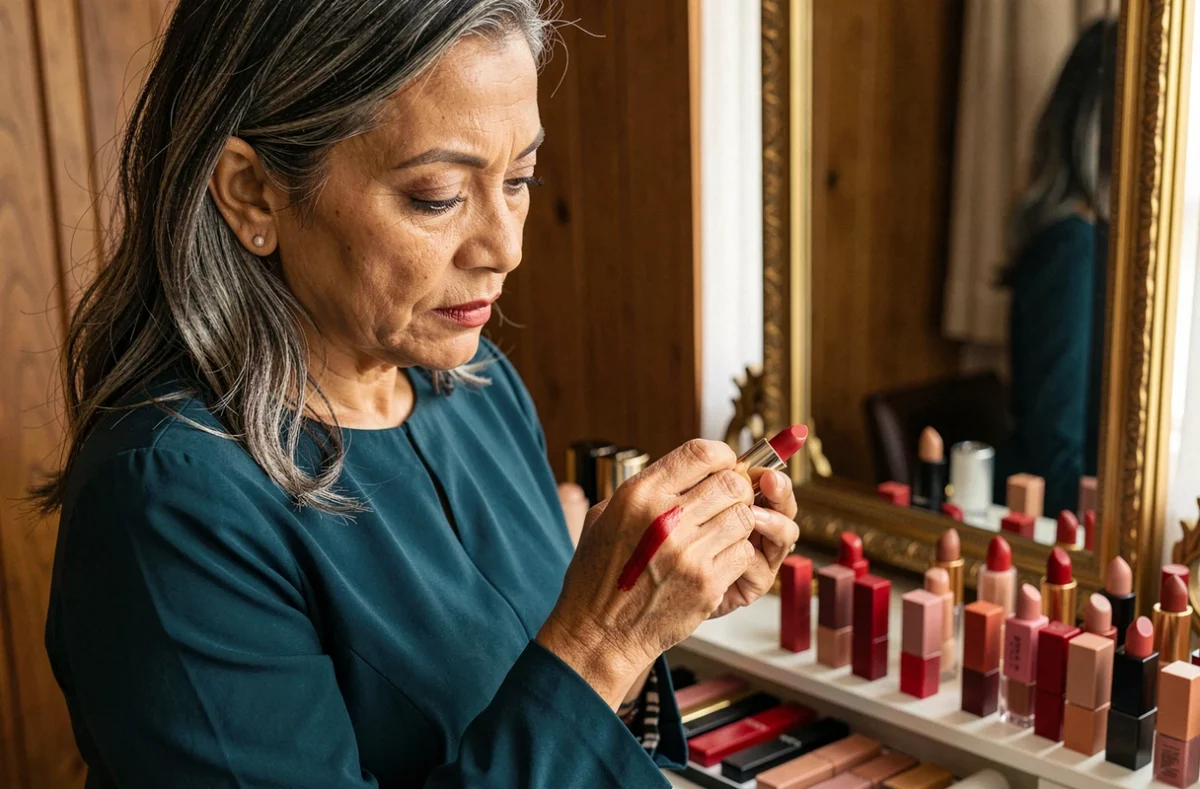
How to apply lipstick on mature lips: the order matters
Applying lipstick to lips that have lost volume and definition is about more than “lining them neatly.” The order of application affects both wear and the final look.
Start by blending a thin layer of concealer or primer around the outer edge of the lips. This neutral base partially fills fine lines and creates a friction zone that helps prevent pigment from feathering. Next, apply lip liner directly along the natural vermilion border (not beyond it, except for minor corrections).
Apply lipstick with a brush rather than straight from the tube to control the thickness of the layer. On mature lips, a thick layer does not last longer: it forms a rigid film that cracks in the folds of the mouth. Two thin layers, with a light blot using a tissue in between, give a longer-lasting result.
Common mistakes that undermine wear
- Applying liner to dry lips: it catches unevenly and creates a visible outline instead of a softly blended line
- Using foundation as a lip base: it dries out the mucous membrane and makes lipstick crack within a few hours
- Layering thick gloss over liquid matte lipstick: the formulas are incompatible; the top layer partially dissolves the matte film and creates a patchy effect
Choosing a color that brightens your smile depends less on the shade itself than on the balance between texture, contrast and skin preparation. A well-applied true red on prepped lips is more rejuvenating than a poorly chosen nude that blends into your complexion.